
I tested five AI tools on a complex brief to create a multi-city itinerary. This article provides my honest review of each with screenshots.
| Tool | Best For | Generates full itinerary | Flights | Hotels | Activities | Dining | Editable | Collaborative planning | Free |
|---|---|---|---|---|---|---|---|---|---|
| Stardrift | Complex, multi-city, business, budget, family | Yes, first response | Yes, bookable with live prices | Yes, bookable | Yes | Yes, including dietary preferences | Drag-and-drop editor | Yes | Yes, no credit card |
| MindTrip | Group travel, social discovery | Yes, with follow-ups | Yes, in-app | Yes, in-app | Yes, via Viator | Yes | Chat and map editor | Yes | Yes, no credit card |
| Gemini | Research-heavy trips, dietary constraints | Yes | Yes, Google Flights | Yes, Google Hotels | Yes | Yes,most detailed | No | No | Yes |
| ChatGPT | Iterative planning, early-stage research | Partial,needs prompting | Yes, via Connected Apps | Yes, via Connected Apps | Yes | Yes,uneven | No | No | Yes |
| Layla | Guided planning with live pricing | Partial, day-by-day behind paywall | Yes, via Skyscanner (premium) | Yes, via Booking.com (premium) | Yes | Yes | Chat only, full editing on premium | No | 3-day trial, $49.99/year after |
How I Tested These AI Travel Planners
Every tool in this comparison was tested against the same brief, submitted without modification:
"Two of us are planning a trip to Japan. I'm flying from London, my partner from New York. We want to arrive in Tokyo on the same day in late October. 12 days total, flying out of Osaka. We want Tokyo, Kyoto, and Osaka, plus 2–3 days of hiking either in Hakone or the Japanese Alps. One of us is a vegetarian. We prefer smaller ryokans over chain hotels, want to avoid the obvious tourist traps, and need to be back by November 3 for work. Build a full day-by-day itinerary with the routing between cities, specific restaurant recommendations, opening hours worth knowing, and what to book in advance."
I evaluated each tool across five criteria:
Screenshots were taken at the time of testing. Pricing shown reflects live rates at the time of each session and will vary. Tools were tested on their free tiers first; paid features are noted where they affected the result.
Which Is the Best AI Travel Planner in 2026?
1. Stardrift
Best for
Travelers who want a preference-driven planner that takes a complex brief and delivers a complete, bookable itinerary without switching between tools.
Honest caveat
Stardrift is a young product. Coverage on niche routes and less-traveled destinations is still expanding.
How it handled the brief
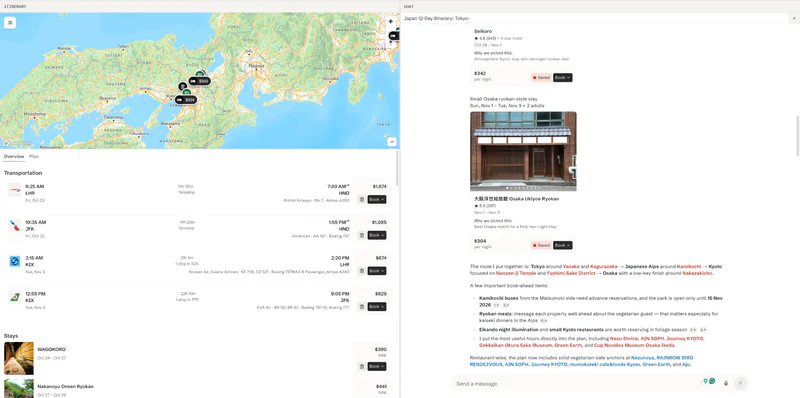
Stardrift returned a complete itinerary on the first response to a demanding multi-city brief. Real flight options with airline names, routes, and live prices. Specific ryokans with per-night costs and a reason for each pick. A vegetarian constraint flagged immediately, with a note to contact each property ahead of time.
The transport logistics included a specific warning that bus reservations to a hiking destination are mandatory and need to be booked alongside trains, not after. That's the kind of detail that prevents a trip from falling apart mid-journey.
Beyond the itinerary itself, Stardrift combines planning, booking, and a live map in one place. Destination cards include traveler reviews and photos.
Flights and hotels are bookable directly within the plan, with current pricing shown. You can share and publish the finished itinerary in a polished format.
For business travelers: Stardrift's conversational assistant handles the decision support that matters on work trips. Comparing arriving the night before versus the morning of, calculating distance from the airport to a meeting venue, and finding flights with Starlink onboard via its Starlink search tool. It's the only planner tested that handles those tradeoffs in a single conversation.
For budget trips: Stardrift respected the stated budget from the first response without correction, no luxury hotels slipped in on the first pass. You can set a budget and filter accommodation and flights accordingly.
For family and group travel: Stardrift supports shared itineraries via a link, collaborative planning, and calendar sync to keep everyone's bookings in one place. Group collaboration features are expanding.
For customized itineraries: The plan lives in a structured editor. Drag and drop days, rearrange stops, and modify individual days without starting over. Import existing bookings from confirmation emails and build around what's already confirmed.
New: Stardrift now imports places straight from TikTok and Instagram Reels and builds a full itinerary around them. Try now.
2. MindTrip
Best for
Suggestions that go well beyond the obvious tourist circuit, thanks to its database of over 11 million points of interest.
Honest caveat
Its depth only surfaces after you push it. Accept the first response, and you'll miss what the tool is actually capable of.
How it handled the brief

MindTrip opened with a clarifying question about arrival day, reasonable. The first hotel suggestions were the Park Hyatt Tokyo and the Ritz-Carlton Osaka, both direct misses on a brief asking for small ryokans under a specific budget.
When corrected, the recommendations improved significantly. It also produced a "not a good fit" table explaining why certain hotels were excluded, a detail no other tool offered. But no restaurants were named across the full 12-day plan; every meal was deferred to a follow-up question MindTrip controlled.
Where MindTrip earns its place: it's designed for the traveler who collects inspiration from TikToks, screenshots, and Google Maps pins before they're ready to plan. Feed it a social link, and it builds an itinerary from that starting point.
Your whole travel party can join a shared chat, add ideas, and shape the itinerary together. Bookings, receipts, and confirmations all live in one place once you start committing.
3. Gemini
Best for
Travelers who prefer to book manually and want the richest possible starting point. Any destination where dietary constraints need careful handling at every meal.
Honest caveat
The depth is front-loaded. Gemini performs best on well-documented destinations with rich indexed content. It runs out of road on niche or later-trip decisions.
How it handled the brief

Gemini produced the most detailed first response of any tool tested. Named restaurants with opening hours, specific dishes, and a vegetarian-safe note at each meal. It questioned the JR Pass recommendation unprompted (the only tool to do so). It made an opinionated routing call with a reason tied to specific conditions. None of that was prompted.
Although by Day 11, the research quality had dropped noticeably. The final night recommendation was a chain restaurant, after genuinely exceptional suggestions earlier in the same trip.
On and all, it's a decent travel planner that also offers the ability to make bookings via Google Flights and Hotels. Gemini pulls live pricing from both when the extensions are enabled in settings and redirects to complete the booking.
4. ChatGPT
Best for
Travelers who know the destination well enough to direct the conversation. Early-stage planning when you're still comparing options.
Honest caveat:
ChatGPT is only as good as what you push on. A traveler who accepts the first output without questioning it will miss things.
How it handled the brief
ChatGPT's first pass had real gaps. Initial hotel suggestions included Gora Kadan, well above the stated budget and not a small ryokan by any definition.
It recommended a full JR Pass without comparing the cost against individual tickets, which for this routing would likely be cheaper. Restaurant suggestions became thinner after Day 8, with two options listed and no guidance on which or why.
Where it earned its place was in follow-ups. When pushed back on a recommendation that contradicted the brief, it swapped it out with an explanation.
The budget breakdown that listed the costs across accommodation, transport, food, and activities as separate line items was the clearest financial presentation of any tool tested.
However, if you're looking to search and book flights and hotels via ChatGPT, it's not as straightforward as Stardrift or Mindtrip. You'll need to connect Expedia or Booking.com via Connected Apps manually.
5. Layla
Best for
Travelers who are comfortable paying for a subscription want live pricing, PriceLock alerts, and a more guided planning experience.
Honest caveat
The full experience, day-by-day itinerary, hotel details, and booking sit behind a paywall. What the free tier shows you is enough to get interested, not enough to plan a trip.
How it handled the brief

Layla's opening was confident. The Alps-over-Hakone reasoning was specific. The vegetarian constraint was flagged early. The tone feels like a conversation, which is deliberate: Layla positions itself as an AI travel agent, not just a planning tool.
The details are where it slipped. Day 3 suggested Mount Takao, one of the most visited mountains in the world at over 2.5 million visitors a year, in a brief that explicitly asked to avoid crowded tourist spots. The ryokan suggestion came before being checked against the $5,000 per person budget. 
Then the paywall appeared. The free tier delivered a skeleton and routed to a subscription for the complete itinerary, hotel details, and expert support. The final message offered to connect us with a human expert to secure the ryokans.
Which AI Travel Planner Is Right for You?
Let's review the best options for different use cases.
Free AI travel planner with no credit card: Stardrift, MindTrip, Gemini, and ChatGPT are all free to start. Layla has a free tier but gates the full itinerary behind a subscription.
AI travel planner app: Stardrift, MindTrip, Gemini, ChatGPT, and Layla all have mobile apps.
AI travel planner with real-time flight suggestions: Stardrift returns live flight options with airline names, routes, and prices directly inside the plan. MindTrip offers in-app booking. Gemini connects to Google Flights when extensions are enabled. ChatGPT requires manually connecting a booking partner.
AI travel planner for business trips: Stardrift handles the tradeoffs that matter for work travel — overnight arrivals vs. morning flights, airport-to-venue distance, and Starlink-equipped flights. It's the only planner in this test built for that kind of decision support.
AI travel planner for budget trips: Stardrift and Gemini both respected budget constraints from the first response without correction. Stardrift lets you set a hard budget and filter flights and accommodation accordingly.
AI travel planner for family vacations: MindTrip and Stardrift both support collaborative planning. Stardrift supports shared itineraries via link and calendar sync. MindTrip has a shared group chat where everyone can add ideas.
AI travel planner for customized itineraries: Stardrift's structured editor lets you drag and drop days, modify individual stops, and import existing bookings from confirmation emails, without starting the plan over.
AI travel planner with real-time updates: Stardrift shows current flight and hotel pricing within the plan. Gemini pulls live pricing from Google Flights and Hotels. ChatGPT's pricing accuracy depends on which Connected Apps are enabled.
Frequently asked questions
1. Which AI travel planner can actually book flights and hotels?
Stardrift, Layla, Gemini, and ChatGPT can redirect to their booking partners, and Mindtrip allows in-app flight and hotel booking.
2. Can any AI planner import travel ideas from Instgram and Tiktok reels?
Yes, both Stardrift and Mindtrip can import travel ideas from Instagram and tiktok. Stardrift saves places for multiple trips, kind of like a bucket list. While Mindtrip does one-off itinerary generation. Some other travel apps worth checking for this use case are Airial (web-only), Vacay, and Expedia Trip Match.
3. What is the best free AI travel planner?
Stardrift, MindTrip, Gemini, and ChatGPT are all free with no credit card required. Layla has a free tier but gates the full itinerary behind a subscription. For end-to-end planning with booking built in, Stardrift is the most complete free option.
4. Which AI travel planner is best for multi-city trips?
Stardrift handles multi-city routing well. It builds a full day-by-day itinerary across multiple cities, suggests transport between them, and lets you edit individual days without rebuilding the whole plan.
5. Which AI travel planner is best for group travel?
MindTrip offers the strongest group features with shared itineraries and group chat. Stardrift enables sharing via a link for viewing and comments.
6. Which AI travel planners work with existing bookings?
Stardrift lets you sync your calendar to import existing bookings and plan around what's already confirmed.
MindTrip lets you forward confirmation emails and builds the rest of the trip around your fixed dates. It also lets you import saved Google Maps pins as a starting point if you've been collecting ideas before you're ready to plan.
7. What is the difference between an AI travel planner, a booking site, and a trip organizer?
Booking sites like Expedia and Google Flights are search engines. You enter dates and a destination and get a list of options. There's no planning logic, just inventory.
Trip organizers like TripIt display bookings you've already made on a timeline.
AI travel planners handle the planning logic itself. You describe what you want and the tool builds a sequenced itinerary around it, routing activities, timing check-ins, and suggesting where to eat near your plans.
8. Which AI travel planner is best for budget trips?
Stardrift and Mindtrip let you set a budget and filter accommodation and flights accordingly.
9. Are AI travel planners accurate?
Activity suggestions and routing generally prove reliable. Pricing accuracy varies and should be verified on booking sites before purchase. Stardrift links to live booking options, which helps, but last-minute price swings are unavoidable.
10. Are AI travel planners better than traditional travel agents?
For straightforward trips, AI planners prove faster and cheaper. Traditional agents retain value for highly complex luxury trips requiring local expertise and specialized arrangements.