
I tested 5 AI travel planners on a Paris-to-Rome trip, and Stardrift performed the best amongst them. It produced the only plan you could book in one sitting. Closely followed by Layla for its "travel agent" experience. It's great for someone looking to hand off the planning and booking to a human agent.
Continue reading for a detailed comparison of all the tools.
How I evaluated these Europe travel planners?
Every tool got the same prompt:
14 days in Europe in October 2026. Flying from JFK. I want Paris, the Swiss Alps, Florence, and Rome. Mid-range hotels, walkable neighbourhoods, around $200 a night. I'd rather take trains than fly between cities where it makes sense. Two adults, no car. Give me a day-by-day plan with flights, inter-city transport, hotels, and activities.
We logged the first response. No re-prompting to rescue a weak answer. Then we checked each output against primary sources: museum opening hours, rail timetables, hotel locations, and airline schedules.
The scoring criteria were fixed before any tool ran. That matters, because Stardrift published this article.
Two tools, Stardrift and Mindtrip, ran with preference profiles built over previous trips. ChatGPT, Layla, and FlipEarth ran without one. We have flagged where that changes a result.
Head-to-head comparison of the top AI travel apps for Europe
1. Stardrift
Stardrift produced the only plan in this test you could book in one sitting. It returned nonstop open-jaw flights, four priced hotels inside budget, and three bookable rail legs with real departure times.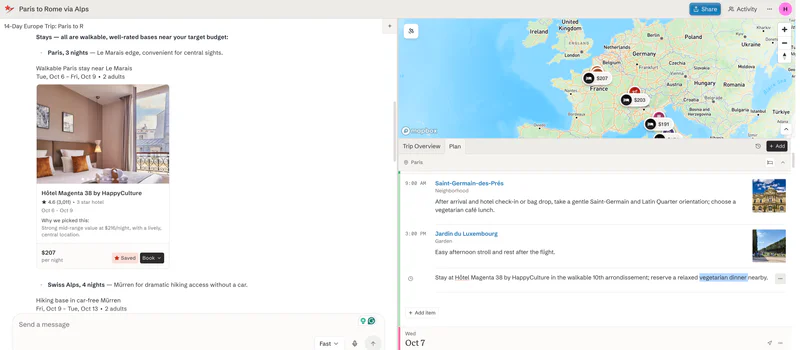
Best for
Booking a multi-city Europe trip end to end, then having your preferences carry into the next one.
Honest caveat
Stardrift scheduled the Vatican Museums for Sunday, October 18, when they are closed. The Vatican Museums shut every Sunday except the last of the month, which in October 2026 was the 25th. Stardrift avoided every other closure trap in the plan, but this one would have cost a morning in Rome. Check any Sunday or Monday museum before booking a timed entry.
How it handled the brief
Flights. Stardrift was the only tool to return nonstop flights in both directions: Air France 11 from JFK to Paris, Delta 183 from Rome to JFK. $1,572 for two in economy, with a Starlink WiFi flag on the results.
Hotels. Four hotels, each priced, rated, and given a one-line reason for the pick. Average $196.46 a night against a $200 brief.
Trains. Three bookable rail legs with operator, departure time, arrival time, and transfer count. No other tool named the train.
Alpine base. Stardrift chose Mürren, which is car-free and sits on the Jungfrau rail line. That is the sharpest read of "no car" any tool made.
Closures avoided. Stardrift put the Louvre on a Wednesday rather than the Tuesday it shuts, and the Uffizi on a Wednesday rather than a Monday.
Preferences applied. Seven of them reached the plan, including vegetarian dining every day, an economy cabin, and a hiking base. The clearest was Florence, where the Oltrarno day suggested a pre-booked ceramics workshop in the artisan district, from a stored interest in pottery.
Preferences overridden. Stardrift used the brief's $200 budget instead of its own stored $300 hotel budget.
2. Layla
Layla is the only tool that hands your finished plan to a human being. A real travel agent reviews the AI's work and completes the booking for you, and Layla does not charge for it.
Best for
Handing an AI-built plan to a human agent who checks it and books it for you, at no cost.
Honest caveat
Layla's itinerary starts before the plane lands. It checked us into a Paris hotel on October 14 and scheduled a Louvre tour plus the Musée d'Orsay for October 15, on a flight that does not land until 4:15 PM that afternoon. That is roughly two days of the plan gone and a hotel night paid for mid-flight. Verify your arrival day before the agent books anything.
How it handled the brief
Booking completeness. Layla returned more bookable components than any other tool. Flights at $1,377 for two. Four priced hotels with star ratings and review counts, averaging $196.50 a night. Three rail legs. An airport transfer.
Bookable activities. Priced per person, such as €64 for a Louvre tour with reserved access. Layla was the only tool to offer these without being asked.
Per-day weather. Layla attached a forecast to every day of the trip. No other tool did.
PDF export. The 14-page file drops about half the app's content and miscounts the number of cities.
3. ChatGPT
ChatGPT out-thought every dedicated tool in this test and cannot book a thing. It was the only tool that reasoned about which weeks of October to travel, and the only one that got the trip length right.
Best for
Working out your route, your dates, and whether the budget is realistic, before you commit to anything.
Honest caveat
ChatGPT returns nothing bookable at any subscription tier. No flight numbers, no live fares, no availability. Its hotel prices are labelled as indicative rather than live, which is honest and also means you start again somewhere else. It also made two closure errors: the Accademia on a Monday when it shuts, and the Brunelleschi Dome on a Sunday morning, when Sunday climbing slots do not open until 12:45.
How it handled the brief
Date selection. ChatGPT picked October 3 to 16 because Swiss mountain lifts and services wind down as October progresses, so it front-loaded Switzerland. No other tool reasoned about when in the month to travel.
Weather insurance. Four nights in one Interlaken hotel gives two possible mountain days, so one bad-weather day does not cost you Switzerland. It named Lucerne as the fallback and warned against non-refundable mountain tickets.
Budget realism. ChatGPT was the only tool to warn that $200 a night would be tight in Switzerland specifically. Layla's results proved the point, with a 6.6-rated basic twin at $200.67.
Train versus fly. ChatGPT laid out rail as its preference against flying, reasoning that airport transfers, security, and bags make the train less painful than the timetable suggests.
Maps. ChatGPT pins hotels only, not activities.
4. Mindtrip
Mindtrip has the most structured preference memory of any tool here, and the thinnest Europe itinerary. It stores how you travel in real detail, then returns a route shape rather than a plan.
Best for
Groups collecting ideas before anyone has committed to dates.
Honest caveat
Mindtrip never commits to anything checkable. No dates on any day, no times, no hotel prices, no train departures. That makes the plan impossible to verify, which is not the same as being accurate. It named four hotels without pricing any, then admitted at the end it could match them to the $200 budget given exact dates.
How it handled the brief
Self-correction. Mindtrip's flight search returned a round trip to Paris when the trip ends in Rome. Rather than quietly serving it, Mindtrip flagged the mismatch, explained the two ways to fix it, and planned the rest as an open-jaw.
Memory structure. Mindtrip stores dietary needs, pace, accommodation style, travel party, planning style, and a travel archetype, behind a long-term memory toggle.
Preferences applied. Four reached the plan: boutique hotels only, no early starts, vegetarian-friendly days, and an architecture-focused day. Stardrift applied seven.
Alpine base. Mindtrip chose Wengen, which like Mürren is car-free and a correct read of the brief.
Inspiration guides: Browse, save, or build from shareable travel guides published by other users.
Group collaboration: Comments and shared ideas on a group itinerary.
I have done a more destination-agnostic Mindtrip review, if you want to check that out.
5. FlipEarth
FlipEarth wrote the richest itinerary in this test and it is not really an AI trip planner. It is a European rail ticket seller with an itinerary generator attached, and its PDF exports as a visa application document.
Best for
Buying European train tickets, or generating an itinerary document for a visa application.
Honest caveat
FlipEarth made six closed-venue errors, the most in the test. The Louvre on a Tuesday. The Musée Rodin and L'Ami Jean on the same Monday. The Uffizi on a Monday. The Testaccio market on a Sunday. The Borghese Gallery on a Monday, on a day that also repeated an attraction from two days earlier.
How it handled the brief
Writing quality. FlipEarth produced five substantial items a day across fifteen days, with street-by-street walking directions, named dishes and prices, and real history. It told me to cross Pont d'Iéna from Trocadéro and that the walk takes eight minutes.
You do the planning, not the AI. You pick the cities and the number of days yourself in a form. There is no chat.
No flights, no hotels. FlipEarth has no flight search, and its accommodation table listed all four cities as "To be confirmed."
No origin field. FlipEarth assumed London with no way to correct it.
The login wall. After filling everything in, FlipEarth demanded a login, then cleared every detail and required re-entry.
Rail detail is thin for a rail company. All three segments were dated a day before the stay they connected. Only one carried a duration or price. The eight-hour Interlaken to Florence leg had neither.
Common Europe trip planning mistakes AI helps you avoid
Backtracking across the continent. Visiting Paris, then Barcelona, then Amsterdam means you fly south then north again. AI reorders cities geographically: Paris, Amsterdam, Barcelona, saving a full travel day and hundreds in transport costs.
Round-tripping when open-jaw is cheaper. Flying SFO to Paris round-trip and then taking a train back from Rome to Paris on day 12 wastes an entire day. An open-jaw flight (into Paris, out of Rome) is often the same price or cheaper and saves that dead travel day.
Booking hotels without checking the neighborhood. A three-star hotel near Gare du Nord in Paris is a different experience than one in Saint-Germain-des-Pres. AI planners that understand neighborhoods prevent the "cheap hotel in a bad location" trap.
Ignoring budget airlines for short hops. A two-hour Ryanair flight from Milan to Lisbon can cost 30 euros. Travelers who only search traditional carriers miss these options. AI planners surface budget airlines alongside trains and full-service flights.
Overpacking the itinerary. Three cities in seven days sounds achievable until you account for travel days, jet lag, and check-in/check-out logistics. AI planners allocate realistic time per city and flag when an itinerary is too compressed.
FAQs
What is the best AI trip planner for Europe in 2026?
Stardrift is the best overall AI trip planner for Europe. It handles multi-city routing, open-jaw flights, train-vs-flight decisions, and neighborhood-level hotel selection from a single natural-language prompt. It also remembers your travel preferences across trips, which is especially useful for repeat Europe travelers.
Can AI plan a multi-country Europe trip with trains and flights?
Yes. Stardrift and Layla both generate multi-country itineraries that mix flights, trains, and buses based on what makes sense for each segment. Stardrift compares door-to-door travel time and cost, not just ticket price, so it might recommend a 3-hour train over a 1.5-hour flight when airport transit time makes the flight slower overall.
Is it better to fly open-jaw or round-trip for a Europe trip?
Open-jaw is almost always better for multi-city Europe trips. Flying into one city and out of another eliminates a backtrack leg that wastes a full travel day. Stardrift evaluates open-jaw routing automatically and recommends the best arrival and departure cities based on your itinerary. Google Flights supports manual open-jaw searches if you already know which cities to use.
Do AI trip planners know about Eurail passes?
Some do. Stardrift factors Eurail pass pricing into its transport recommendations and will suggest a pass when it saves money over point-to-point tickets for your specific route. Most other AI planners recommend individual train tickets but don't compare against pass pricing. For a dedicated pass calculator, check the official Eurail website.
How do I plan a two-week Europe trip with AI?
Start with a prompt that includes your departure city, the European cities or regions you want to visit, your trip length, budget level, and any preferences (boutique hotels, vegetarian restaurants, walkable neighborhoods).
Stardrift generates a complete day-by-day itinerary with flights, inter-city transport, hotels, activities, and dining; then lets you edit anything.
Are AI-generated Europe itineraries accurate?
AI itineraries are structurally sound. Routing, timing, and activity sequencing are generally reliable. However, specific prices may be estimated rather than live, and opening hours or seasonal closures can change. Always verify key bookings (flights, hotels, timed-entry tickets) directly before purchasing. Stardrift links to booking sources so you can confirm real-time availability.
Can I use an AI trip planner for a Europe backpacking trip?
Yes. Set your budget parameters in the prompt. Mention hostels, budget airlines, and a daily spending target and AI planners adjust recommendations accordingly.
Stardrift handles budget Europe planning well because it surfaces Ryanair, Wizz Air, FlixBus, and hostel options alongside standard recommendations.