
J'ai testé 5 planificateurs de voyage IA sur un itinéraire Paris-Rome, et Stardrift s'est révélé le plus performant. C'est le seul à avoir produit un plan réservable d'une seule traite. Layla suit de près grâce à son expérience « agence de voyages » : idéale pour qui souhaite confier la planification et la réservation à un conseiller humain.
Poursuivez votre lecture pour une comparaison détaillée de tous les outils.
Comment ai-je évalué ces planificateurs de voyage pour l'Europe ?
Chaque outil a reçu la même consigne :
14 jours en Europe en octobre 2026. Départ de JFK. Je veux Paris, les Alpes suisses, Florence et Rome. Hôtels de gamme moyenne, quartiers où l'on peut tout faire à pied, environ 200 $ la nuit. Je préfère le train à l'avion entre les villes quand c'est pertinent. Deux adultes, sans voiture. Donne-moi un programme jour par jour avec vols, transports entre les villes, hôtels et activités.
Nous avons consigné la première réponse. Aucune relance pour rattraper une réponse faible. Nous avons ensuite confronté chaque résultat aux sources primaires : horaires d'ouverture des musées, grilles horaires ferroviaires, emplacements des hôtels et programmes des compagnies aériennes.
Les critères de notation ont été fixés avant le moindre test. Cela compte, car c'est Stardrift qui publie cet article.
Deux outils, Stardrift et Mindtrip, ont fonctionné avec des profils de préférences construits lors de voyages précédents. ChatGPT, Layla et FlipEarth ont tourné sans. Nous signalons les cas où cela change le résultat.
Comparatif direct des meilleures applications de voyage IA pour l'Europe
1. Stardrift
Stardrift a produit le seul plan de ce test que l'on pouvait réserver d'une seule traite. Il a proposé des vols open-jaw sans escale, quatre hôtels tarifés dans le budget et trois trajets ferroviaires réservables avec de véritables horaires de départ.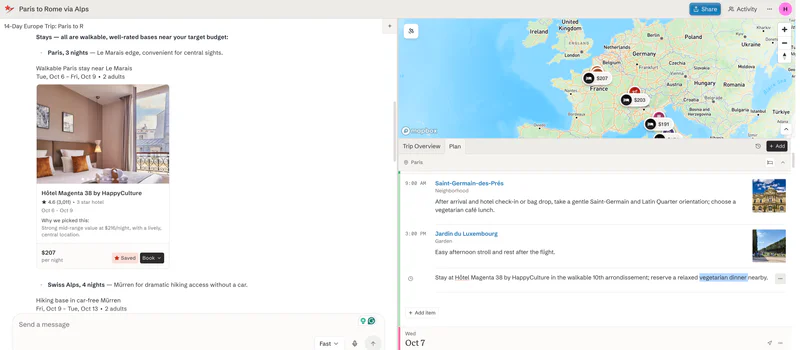
Idéal pour
Réserver un voyage multi-villes en Europe de bout en bout, puis retrouver ses préférences lors du voyage suivant.
La réserve en toute transparence
Stardrift a programmé les musées du Vatican pour le dimanche 18 octobre, jour de fermeture. Les musées du Vatican ferment tous les dimanches, sauf le dernier du mois, soit le 25 en octobre 2026. Stardrift a évité tous les autres pièges de fermeture du programme, mais celui-ci aurait coûté une matinée à Rome. Vérifiez les horaires de tout musée un dimanche ou un lundi avant de réserver un créneau horodaté.
Comment il a traité la demande
Vols. Stardrift est le seul outil à avoir proposé des vols sans escale dans les deux sens : Air France 11 de JFK à Paris, Delta 183 de Rome à JFK. 1 572 $ pour deux en classe économique, avec une mention Starlink WiFi dans les résultats.
Hôtels. Quatre hôtels, chacun tarifé, noté et accompagné d'une justification en une ligne. Moyenne de 196,46 $ la nuit pour un budget annoncé de 200 $.
Trains. Trois trajets ferroviaires réservables avec opérateur, heure de départ, heure d'arrivée et nombre de correspondances. Aucun autre outil n'a nommé le train.
Camp de base alpin. Stardrift a choisi Mürren, village sans voitures situé sur la ligne ferroviaire de la Jungfrau. C'est la lecture la plus fine du « sans voiture » parmi tous les outils.
Fermetures évitées. Stardrift a placé le Louvre un mercredi plutôt que le mardi, jour de fermeture, et les Offices un mercredi plutôt qu'un lundi.
Préférences appliquées. Sept d'entre elles se sont retrouvées dans le plan, dont des repas végétariens chaque jour, une cabine économique et un camp de base pour la randonnée. La plus évidente concernait Florence : la journée dans l'Oltrarno proposait un atelier de céramique à réserver à l'avance dans le quartier des artisans, à partir d'un intérêt enregistré pour la poterie.
Préférences écartées. Stardrift a retenu le budget de 200 $ de la demande plutôt que son propre budget hôtelier enregistré de 300 $.
Essayez Stardrift dès maintenant, c'est gratuit !
2. Layla
Layla est le seul outil à transmettre votre plan finalisé à un être humain. Un véritable agent de voyages vérifie le travail de l'IA et finalise la réservation à votre place, et Layla ne facture rien pour ce service.
Idéal pour
Confier un plan conçu par l'IA à un agent humain qui le vérifie et le réserve pour vous, sans frais.
La réserve en toute transparence
L'itinéraire de Layla commence avant l'atterrissage de l'avion. Il nous a fait enregistrer dans un hôtel parisien le 14 octobre et a programmé une visite du Louvre ainsi que le musée d'Orsay le 15 octobre, alors que le vol n'atterrit qu'à 16 h 15 cet après-midi-là. Soit environ deux jours de programme perdus et une nuit d'hôtel payée en plein vol. Vérifiez votre jour d'arrivée avant que l'agent ne réserve quoi que ce soit.
Comment il a traité la demande
Exhaustivité des réservations. Layla a proposé davantage d'éléments réservables que tout autre outil. Vols à 1 377 $ pour deux. Quatre hôtels tarifés avec étoiles et nombre d'avis, pour une moyenne de 196,50 $ la nuit. Trois trajets ferroviaires. Un transfert aéroport.
Activités réservables. Tarifées par personne, comme 64 € pour une visite du Louvre avec accès réservé. Layla est le seul outil à les proposer spontanément.
Météo quotidienne. Layla a associé des prévisions à chaque journée du voyage. Aucun autre outil ne l'a fait.
Export PDF. Le fichier de 14 pages omet environ la moitié du contenu de l'application et se trompe sur le nombre de villes.
3. ChatGPT
ChatGPT a raisonné mieux que tous les outils spécialisés de ce test, et il ne peut rien réserver. C'est le seul à s'être demandé quelles semaines d'octobre privilégier, et le seul à avoir calculé correctement la durée du voyage.
Idéal pour
Définir votre itinéraire, vos dates et la faisabilité de votre budget, avant de vous engager sur quoi que ce soit.
La réserve en toute transparence
ChatGPT ne propose rien de réservable, quel que soit le niveau d'abonnement. Pas de numéros de vol, pas de tarifs en direct, pas de disponibilités. Ses prix d'hôtels sont présentés comme indicatifs plutôt qu'en temps réel : c'est honnête, mais cela signifie aussi que vous devrez tout recommencer ailleurs. Il a également commis deux erreurs de fermeture : l'Accademia un lundi, jour de fermeture, et le dôme de Brunelleschi un dimanche matin, alors que les créneaux d'ascension du dimanche n'ouvrent qu'à 12 h 45.
Comment il a traité la demande
Choix des dates. ChatGPT a retenu du 3 au 16 octobre parce que les remontées mécaniques et les services suisses réduisent la voilure au fil du mois ; il a donc placé la Suisse en début de parcours. Aucun autre outil n'a raisonné sur le moment du mois où voyager.
Assurance météo. Quatre nuits dans un même hôtel à Interlaken offrent deux journées possibles en montagne : une journée de mauvais temps ne vous prive donc pas de la Suisse. Il a désigné Lucerne comme solution de repli et déconseillé les billets de montagne non remboursables.
Réalisme budgétaire. ChatGPT est le seul outil à avoir averti que 200 $ la nuit seraient justes en Suisse en particulier. Les résultats de Layla lui donnent raison, avec une chambre twin basique notée 6,6 à 200,67 $.
Train ou avion. ChatGPT a privilégié le rail à l'avion, en expliquant que les transferts vers l'aéroport, les contrôles de sécurité et les bagages rendent le train moins pénible que ne le laisse penser la grille horaire.
Cartes. ChatGPT n'épingle que les hôtels, pas les activités.
4. Mindtrip
Mindtrip possède la mémoire des préférences la plus structurée de tous les outils testés, et l'itinéraire européen le plus maigre. Il enregistre votre façon de voyager dans le détail, puis renvoie une esquisse de parcours plutôt qu'un véritable plan.
Idéal pour
Les groupes qui rassemblent des idées avant que quiconque ne se soit engagé sur des dates.
La réserve en toute transparence
Mindtrip ne s'engage jamais sur un élément vérifiable. Aucune date sur les journées, pas d'horaires, pas de prix d'hôtels, pas de départs de trains. Le plan en devient impossible à vérifier, ce qui n'équivaut pas à être exact. Il a cité quatre hôtels sans en tarifer aucun, avant d'admettre à la fin qu'il pourrait les faire correspondre au budget de 200 $ si on lui donnait des dates précises.
Comment il a traité la demande
Autocorrection. La recherche de vols de Mindtrip a renvoyé un aller-retour vers Paris alors que le voyage se termine à Rome. Plutôt que de le servir discrètement, Mindtrip a signalé l'incohérence, expliqué les deux façons d'y remédier et planifié le reste en open-jaw.
Structure de la mémoire. Mindtrip enregistre les contraintes alimentaires, le rythme, le style d'hébergement, la composition du groupe, la façon de planifier et un archétype de voyageur, derrière une option de mémoire à long terme.
Préférences appliquées. Quatre sont arrivées jusqu'au plan : hôtels de charme uniquement, pas de départs matinaux, journées adaptées aux végétariens et une journée axée sur l'architecture. Stardrift en a appliqué sept.
Camp de base alpin. Mindtrip a choisi Wengen qui, comme Mürren, est sans voitures : une lecture juste de la demande.
Guides d'inspiration : parcourez, enregistrez ou construisez à partir de guides de voyage partageables publiés par d'autres utilisateurs.
Collaboration de groupe : commentaires et idées partagées sur un itinéraire collectif.
J'ai rédigé un avis sur Mindtrip plus généraliste, sans destination particulière, si cela vous intéresse.
5. FlipEarth
FlipEarth a rédigé l'itinéraire le plus riche de ce test, et ce n'est pas vraiment un planificateur de voyage IA. C'est un vendeur de billets de train européens doté d'un générateur d'itinéraires, dont le PDF s'exporte sous forme de document pour demande de visa.
Idéal pour
Acheter des billets de train européens ou générer un document d'itinéraire pour une demande de visa.
La réserve en toute transparence
FlipEarth a commis six erreurs de lieux fermés, le record du test. Le Louvre un mardi. Le musée Rodin et L'Ami Jean le même lundi. Les Offices un lundi. Le marché du Testaccio un dimanche. La galerie Borghèse un lundi, lors d'une journée qui reprenait en plus une attraction déjà proposée deux jours plus tôt.
Comment il a traité la demande
Qualité rédactionnelle. FlipEarth a produit cinq propositions substantielles par jour sur quinze jours, avec des itinéraires pédestres rue par rue, des plats et des prix précis, et de vraies notes historiques. Il m'a indiqué de traverser le pont d'Iéna depuis le Trocadéro et précisé que la marche prend huit minutes.
C'est vous qui planifiez, pas l'IA. Vous choisissez vous-même les villes et le nombre de jours dans un formulaire. Il n'y a pas de chat.
Ni vols, ni hôtels. FlipEarth ne propose aucune recherche de vols, et son tableau d'hébergements indiquait « À confirmer » pour les quatre villes.
Pas de champ ville de départ. FlipEarth a supposé Londres, sans possibilité de corriger.
Le mur d'inscription. Après avoir tout rempli, FlipEarth a exigé une connexion, puis a effacé toutes les informations et imposé de les ressaisir.
Des détails ferroviaires maigres pour une compagnie ferroviaire. Les trois segments étaient datés d'un jour avant le séjour qu'ils reliaient. Un seul indiquait une durée ou un prix. Le trajet de huit heures entre Interlaken et Florence n'avait ni l'un ni l'autre.
Les erreurs classiques de planification d'un voyage en Europe que l'IA vous aide à éviter
Faire des allers-retours à travers le continent. Visiter Paris, puis Barcelone, puis Amsterdam revient à descendre vers le sud avant de remonter au nord. L'IA réorganise les villes selon la géographie : Paris, Amsterdam, Barcelone, ce qui vous fait gagner une journée entière de trajet et des centaines d'euros de transport.
Prendre un aller-retour quand l'open-jaw revient moins cher. Voler de SFO à Paris en aller-retour puis reprendre le train de Rome à Paris au 12e jour gâche une journée entière. Un vol open-jaw (arrivée à Paris, départ de Rome) coûte souvent le même prix, voire moins, et vous épargne cette journée perdue.
Réserver un hôtel sans vérifier le quartier. Un hôtel trois étoiles près de la gare du Nord à Paris n'a rien à voir avec un hôtel à Saint-Germain-des-Prés. Les planificateurs IA qui comprennent les quartiers évitent le piège de « l'hôtel pas cher mais mal situé ».
Négliger les compagnies low cost pour les courts trajets. Un vol Ryanair de deux heures entre Milan et Lisbonne peut coûter 30 euros. Les voyageurs qui ne consultent que les compagnies traditionnelles passent à côté de ces options. Les planificateurs IA font remonter les compagnies low cost aux côtés des trains et des vols classiques.
Surcharger l'itinéraire. Trois villes en sept jours semble réalisable, jusqu'à ce qu'on compte les journées de trajet, le décalage horaire et la logistique des arrivées et départs d'hôtel. Les planificateurs IA attribuent un temps réaliste à chaque ville et signalent quand un itinéraire est trop comprimé.
FAQ
Quel est le meilleur planificateur de voyage IA pour l'Europe en 2026 ?
Stardrift est globalement le meilleur planificateur de voyage IA pour l'Europe. Il gère les itinéraires multi-villes, les vols open-jaw, les arbitrages train/avion et la sélection d'hôtels à l'échelle du quartier, à partir d'une simple consigne en langage naturel. Il mémorise aussi vos préférences d'un voyage à l'autre, ce qui est particulièrement utile si vous revenez souvent en Europe.
L'IA peut-elle planifier un voyage en Europe dans plusieurs pays, avec trains et avions ?
Oui. Stardrift et Layla génèrent tous deux des itinéraires multi-pays qui combinent vols, trains et bus selon ce qui est le plus pertinent pour chaque segment. Stardrift compare le temps et le coût de porte à porte, pas seulement le prix du billet : il peut donc recommander un train de 3 heures plutôt qu'un vol d'1 h 30 lorsque les trajets vers l'aéroport rendent l'avion plus lent au total.
Vaut-il mieux voler en open-jaw ou en aller-retour pour un voyage en Europe ?
L'open-jaw est presque toujours préférable pour les voyages multi-villes en Europe. Arriver dans une ville et repartir d'une autre élimine un trajet de retour en arrière qui gâche une journée entière. Stardrift évalue automatiquement les itinéraires open-jaw et recommande les meilleures villes d'arrivée et de départ selon votre programme. Google Flights permet des recherches open-jaw manuelles si vous savez déjà quelles villes utiliser.
Les planificateurs IA connaissent-ils les pass Eurail ?
Certains, oui. Stardrift intègre le tarif du pass Eurail à ses recommandations de transport et suggère un pass lorsqu'il revient moins cher que des billets point à point sur votre trajet précis. La plupart des autres planificateurs IA recommandent des billets de train individuels sans les comparer au prix des pass. Pour un calculateur de pass dédié, consultez le site officiel d'Eurail.
Comment planifier un voyage de deux semaines en Europe avec l'IA ?
Commencez par une consigne qui précise votre ville de départ, les villes ou régions européennes que vous souhaitez visiter, la durée du voyage, le niveau de budget et vos éventuelles préférences (hôtels de charme, restaurants végétariens, quartiers où l'on circule à pied).
Stardrift génère un itinéraire complet jour par jour avec vols, transports entre les villes, hôtels, activités et restaurants ; vous pouvez ensuite tout modifier.
Les itinéraires européens générés par l'IA sont-ils fiables ?
Les itinéraires produits par l'IA sont structurellement solides. Le parcours, le rythme et l'enchaînement des activités sont généralement fiables. En revanche, certains prix peuvent être estimés plutôt qu'en temps réel, et les horaires d'ouverture ou les fermetures saisonnières peuvent évoluer. Vérifiez toujours les réservations clés (vols, hôtels, billets à créneau horaire) directement avant de payer. Stardrift renvoie vers les sources de réservation pour que vous puissiez confirmer les disponibilités en temps réel.
Puis-je utiliser un planificateur IA pour un voyage en Europe sac au dos ?
Oui. Précisez vos paramètres de budget dans la consigne. Mentionnez les auberges de jeunesse, les compagnies low cost et un objectif de dépenses quotidiennes : les planificateurs IA ajusteront leurs recommandations en conséquence.
Stardrift gère bien la planification à petit budget en Europe, car il fait remonter Ryanair, Wizz Air, FlixBus et les auberges de jeunesse aux côtés des suggestions classiques.