
Japan ranks #3 globally for honeymoons in 2026, according to the Honeyfund annual report. Private onsens, kaiseki dining, city-plus-mountain combinations, and genuine safety set it apart from almost anywhere else you could go. If you've been wondering whether it holds up against Europe, the short answer is yes, differently.
Key Takeaways
The classic Japan honeymoon itinerary is Tokyo + Hakone + Kyoto. 10 days covers it well; 14 days lets you add a stop like Kanazawa or Miyajima.
Public onsens in Japan are gender-segregated. For a honeymoon, book a ryokan with a kashikiri onsen, a private outdoor bath for two.
Cherry blossom (late March to early April) is peak season for a reason, but it's also peak prices and crowds. March–May and September–November are strong alternatives.
The best Kyoto ryokans during cherry blossom book out 6 to 12 months in advance. Book accommodation before flights.
Stardrift can build your day-by-day Japan itinerary around your preferences with bookable flights and filter accommodation by private onsen availability.
Is Japan a good honeymoon destination?
Japan is an excellent honeymoon destination. It ranks #3 globally behind Hawaii and Italy, mainly because very few countries combine privacy, world-class food, safety, and a strong sense of place the way Japan does.
The "Is it as romantic as Europe?" question is worth addressing directly. It's a different kind of romantic. Paris gives you grand cafes and public beauty. Japan gives you a private tatami room, a kaiseki dinner served course by course at your low table, and a cedar-lined outdoor bath with mountain views. For most couples, that turns out to be more intimate, not less.
A few things that make Japan work especially well for honeymoons:
Private onsens: Find ryokans with a kashikiri onsen, a private outdoor bath you reserve exclusively for two. This is standard at better ryokans but needs to be confirmed at booking. If you'd rather not research this manually, Stardrift filters accommodation by onsen type when building your itinerary.
Kaiseki dining: Tokyo has more Michelin-starred restaurants than any other city in the world, with 160 starred restaurants in 2026. A multi-course kaiseki dinner at a Kyoto ryokan is one of the most memorable meals a couple can have.
Safety: Japan consistently ranks among the safest countries for tourists. You can walk back to your hotel late at night in Tokyo or Kyoto without thinking twice.
City and nature in one trip: Three days in Tokyo, a short train ride to a mountain onsen town, then four days in Kyoto's temple gardens. The variety keeps even a longer trip from feeling monotonous.
When is the best time for a honeymoon in Japan?
Cherry blossom season (late March to early April) and autumn foliage (November) are the peak romance windows. Both are genuinely beautiful, and both are busy. If those windows don't fit your schedule, spring broadly from March through May, and autumn from September through November offer good weather with fewer crowds than the peak weeks.
Late March to early April: Cherry blossom peak. Tokyo typically blooms around late March; Kyoto follows a few days later, usually early April. This is the most sought-after window for couples. Prices and bookings reflect it. The best ryokans in Kyoto fill 6 to 12 months in advance.
May: Post-blossom but still warm and green. Golden Week (late April to early May) brings heavy domestic crowds, so aim for mid-May if possible.
September to November: Arguably the most balanced window of the year. Typhoon season winds down by October. Autumn foliage in Kyoto and Nikko peaks in mid-to-late November. Fewer tourists than cherry blossom, and prices follow.
Winter (December to February): Mild by American and European standards. Fewer tourists, lower prices. A particular kind of magic if you stay at a ryokan with a rotenburo, an outdoor onsen.
Sitting in a hot outdoor bath while snow falls around you is one of those experiences that's hard to replicate anywhere else. Japan in winter has more to offer than most couples expect. Our Japan ski trip guide covers the full picture if you're planning a longer stay
Where should you go for a Japan honeymoon?
Tokyo, Kyoto, and Hakone form the classic honeymoon route. They deliver city energy, historic culture, and mountain scenery in a single trip, all connected by fast trains. Kanazawa and Kinosaki Onsen are the strongest alternatives for couples who want fewer tourists and a deeper sense of old Japan.
Hakone
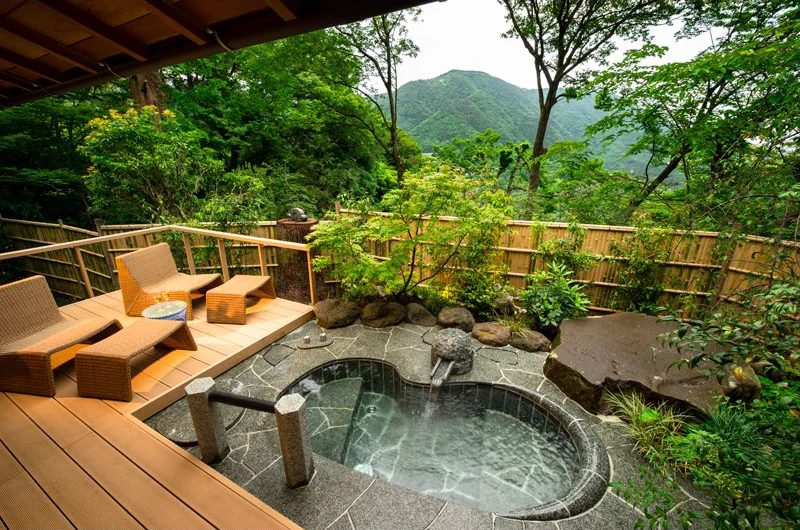
Hakone is the easiest escape from Tokyo. It sits about 80 minutes away by Romancecar, a reserved scenic train that's become something of a honeymoon institution in itself. On a clear day, Mt. Fuji is visible from multiple points around town.
Hakone's core offering for couples is private onsen ryokans: multi-course dinners served in your room, cedar-lined outdoor baths, and no particular reason to leave until check-out. Two nights here is the right amount for most itineraries.
Kyoto

Kyoto is the emotional centre of most Japan honeymoons. Ryokans in the Higashiyama hills, kaiseki restaurants that book out months in advance, the Arashiyama bamboo grove (best before 7am, before tour groups arrive), Fushimi Inari's torii gate tunnel, and the Gion district where the streets feel genuinely old at dusk. Kyoto rewards slow travel. Three nights is a minimum; four is better. Spring and autumn are the peak seasons, and the city earns both reputations.
Tokyo

Tokyo gets undersold as a honeymoon destination. It has some of the world's best restaurants, design hotels with extraordinary attention to detail, and neighbourhoods like Yanaka and Shimokitazawa that feel genuinely local rather than tourist-facing. The energy is high, which makes it a natural start to the trip. Use it to recover from jet lag, eat well, and explore before heading south to slower places.
Kanazawa

Kanazawa is often described as Kyoto without the crowds. That's roughly accurate. It has a preserved geisha district (Higashi Chaya), one of Japan's three great gardens (Kenroku-en), excellent seafood from the Japan Sea coast, and a growing number of high-quality ryokans. The Shinkansen from Tokyo takes about 2.5 hours. For couples who want old Japan without the tour buses, it's the best alternative to Kyoto.
Kinosaki Onsen

Kinosaki is a small onsen town on the Japan Sea coast with seven public bathhouses on a willow-lined canal. Guests stay at ryokans, put on yukata robes and wooden sandals, and wander between the baths on foot. There's almost nothing to do except eat, bathe, and walk. That's entirely the point. For couples who want to fully decompress, Kinosaki delivers better than anywhere else on this list.
What does a Japan honeymoon itinerary look like?
10 days covers the essential route well. 14 days lets you go deeper without rushing. The core principle: two or three bases work better than six rushed stops. Less time moving means more time actually being somewhere.
10-Day Japan Honeymoon Itinerary
Tokyo to Osaka, with a night in the mountains
Days 1–3: Tokyo
Morning: Recover from the flight. Pick one neighbourhood per day rather than crossing the city. Shibuya and Shinjuku for orientation on day one.
Afternoon: Yanaka for the old Tokyo atmosphere. Harajuku or Omotesando for design, cafes, and food.
Evening: Dinner in Ginza or Shinjuku. Tokyo's restaurant scene rewards advance research. Book before you leave home.
Days 4–5: Hakone
Leave Tokyo behind and check into the mountains
Morning: Romancecar from Shinjuku. Arrive by midday. Check into your ryokan. No agenda for the afternoon.
Afternoon: Hakone Open Air Museum if the weather is poor. Lake Ashi cruise and ropeway for Mt. Fuji views if it's clear.
Evening: Kaiseki dinner at the ryokan. Private onsen after.
Days 6–8: Kyoto
The slow heart of the trip
Morning: Fushimi Inari before 7am. Arashiyama bamboo grove before 8am. Both are worth the early start. Both become crowded by 9am.
Afternoon: Higashiyama district walk. Philosopher's Path. Pick one temple to spend proper time at rather than rushing five.
Evening: Dinner in Gion. Pontocho alley for atmosphere. Book kaiseki at least 2 months out.
Days 9–10: Osaka + Nara
City food and ancient deer
Morning: Day trip to Nara. Todai-ji temple and the deer park. 45 minutes by train from Osaka. Go early before school groups arrive.
Afternoon: Return to Osaka. Dotonbori for street food: takoyaki, okonomiyaki, kushikatsu.
Evening: Final dinner in Osaka before flying home from KIX, or connecting back to Tokyo for an international flight from HND or NRT.
14-Day Japan Honeymoon Itinerary
The same core route with room to breathe, plus one more stop
Run the same structure as above and add one of the following, depending on what you're looking for:
Kanazawa (2 nights): Break the Tokyo-to-Kyoto journey here. Shinkansen from Tokyo takes 2.5 hours. Kenroku-en garden, the Higashi Chaya district, and excellent Japan Sea seafood. Continue south to Kyoto on day 3.
Miyajima (1–2 nights): Add after Osaka. The floating torii of Itsukushima Shrine at high tide is genuinely striking. Best experienced with an overnight stay, after day-trippers have gone.
Naoshima (1–2 nights): Japan's art island in the Seto Inland Sea. Yayoi Kusama's pumpkins, the Chichu Art Museum, and a pace that's slower than anywhere else on this list. Best for couples with a design or contemporary art interest.
What accommodation should you book for a Japan honeymoon?
Ryokans and boutique hotels offer different things, and most couples do both. Ryokans are the more distinctly Japanese experience: tatami floors, futon bedding, yukata robes, and a kaiseki dinner served in your room. A good ryokan in Kyoto or Hakone is as much the destination as anything outside it. Boutique hotels give you more familiar comforts, often better city-centre locations, and more flexibility with where you eat.
The most common approach for a honeymoon: a design hotel in Tokyo, a ryokan in Hakone, another ryokan or boutique hotel in Kyoto. That combination covers the range without forcing you to choose one over the other.
One point worth understanding before you book: most Japanese onsen facilities are gender-segregated by default. Couples wanting to use the bath together need to look specifically for a kashikiri onsen, a private outdoor bath reserved exclusively for your room. This is standard at higher-end ryokans but not universal. Confirm it before booking, not after.
Pricing by tier (2026 estimates, per night for two):
Budget: $65–$100/night. Business hotels with good transit access. Some ryokan-style guesthouses with shared facilities. A handful of well-designed hostels at this price point include onsen access, which is worth knowing.
Mid-range: $130–$500/night. Business hotels sit around $150/night. Full ryokans with dinner and breakfast included start around $500/night per room. Most couples alternate between the two, spending more on ryokan nights and less on city hotel nights.
Premium: $1,000+/night. Luxury ryokans with private onsen rooms, full kaiseki service, and dedicated staff. Aman Kyoto, Hoshinoya, and similar properties sit in this range.
One important detail: ryokan pricing in Japan is typically per person, not per room. A ¥30,000 per-person rate means ¥60,000 per night for two. Factor this in when comparing prices.
If you're planning a Kyoto stay during cherry blossom season (late March to early April), book as early as you possibly can. The best ryokans fill 6 to 12 months in advance. This is not an exaggeration.
Ditch the hassle of finding the right stays and let Stardrift do the research for you. Try it for free.
How much does a Japan honeymoon cost?
Flights from North America or Europe typically account for 40 to 60 percent of the total budget. Price those first, then build accommodation and daily costs around what remains.
Budget (for two, 10 days): $6,000–$8,000 total. Economy flights at around $1,000 per person. Hotels at $100/night. Food and local transport at $50–$70 per day. ZipAir from select North American cities can bring flights lower if booked well ahead of departure.
Mid-range (for two, 10 days): $10,000–$14,000 total. Economy flights at around $1,000 per person. A mix of business hotels ($150/night) and ryokans ($500+/night), plus $100–$150 per day for dining and transport.
Premium (for two, 10 days): $20,000 and upward, with no real ceiling. Business class on JAL or ANA runs $6,000 or more per person. Luxury ryokans and Four Seasons-tier hotels add $1,000–$2,000 per night. A fully premium trip from North America or Europe can comfortably reach $35,000 for two, and goes higher from there with first-class flights.
The 7-day JR Pass costs ¥50,000 (roughly $330) and covers the Shinkansen on most major routes. It's worth buying if you're doing the Tokyo-to-Kyoto or Tokyo-to-Osaka route as a round trip. If you're travelling one way and flying home from a different city, individual tickets may be cheaper. Check your specific route before committing.
If you want to search flights and hotels in one place before committing, see our roundup of the best AI tools that consolidate flight-hotel search.
What should you book before you go?
Japan rewards planning more than most destinations. Here's what to lock in before you leave:
Ryokans: Book these first, before flights if possible. The best properties in Kyoto and Hakone fill 6 to 12 months ahead during cherry blossom and autumn foliage seasons.
Visit Japan Web: Register before you leave. This free government portal lets you pre-complete immigration and customs forms and receive a QR code that speeds you through the digital lanes on arrival. Not mandatory, but worth doing. Complete it at least 6 hours before you land.
JR Pass: The 7-day pass costs ¥50,000. Buy it before you arrive in Japan. Covers the Shinkansen between Tokyo, Kyoto, Osaka, and most major routes. Not always the cheapest option for a one-way route, so check your specific journey.
Restaurant reservations: For high-end kaiseki in Kyoto, book at least 2 months out. Services like Tableall specialise in securing tables at hard-to-get restaurants for foreign visitors and are worth using.
Arashiyama and Fushimi Inari: No reservations needed, but arrive early. Before 7am for Arashiyama's bamboo grove, before 8am for Fushimi Inari's lower gates. Both fill up fast.
Pocket wifi or SIM card: Order before you land. Navigation and translation apps are essential, and airport pickup is faster than buying on arrival.
Plan your Japan honeymoon with Stardrift
Stardrift is one of the best AI travel planners that builds a personalised day-by-day itinerary around your preferences.
For your Japan honeymoon specifically, it can handle multi-city routing, ryokans that need to be booked months out, private onsen availability that varies by property, and dietary restrictions that matter most when kaiseki is on the menu.
Top features:
Live flight and hotel prices and booking options within the planning interface
Gmail booking detection (beta), Google Calendar sync, Outlook sync
A memory of your preferred airlines, hotel brands, dietary needs, and other special requests
Day-by-day itinerary with activities sequenced by neighborhood, timing adjusted for arrival times and check-in windows
Drag-and-drop editor with live map view
Starlink in-flight wifi availability by route and airline
Trip collaboration: invite links, @mentions, morning digest of overnight changes
New: Stardrift now imports places straight from TikTok and Instagram Reels and builds a full itinerary around them.
Start planning on Stardrift. It’s free, no credit card required.
Frequently asked questions
Is Japan safe for a honeymoon?
Yes. Japan consistently ranks among the safest countries in the world for tourists. Violent crime rates are extremely low. You can walk back to your hotel late at night in Tokyo or Kyoto without concern. Petty theft is also rare by international standards.
Do you need to speak Japanese when visiting Japan?
No. Major cities have English signage in train stations, most hotel staff speak some English, and Google Translate handles menus and signs well. In smaller towns like Kinosaki Onsen, English is less common, but a combination of pointing, smiling, and translation apps gets you through almost every situation.
Is Japan more romantic than Bali or Paris?
It depends what you mean by romantic. Paris is about grand gestures and public beauty. Bali is about warmth and resort luxury. Japan is about privacy, precision, and experience. A private onsen ryokan in Hakone or a kaiseki dinner in Kyoto offers a different kind of intimacy, more inward-facing than performative. For many couples, it ends up being the most romantic trip they've taken.
How far in advance should you book a Japan honeymoon?
For peak season (late March to early April or November), book ryokans 6 to 12 months ahead. Flights are best booked 3 to 4 months out for the best prices. Outside peak windows, 3 to 4 months of lead time is generally enough for most bookings, though popular ryokans can still sell out faster than you'd expect.
What if you're not interested in temples and shrines ?
You can build an excellent Japan honeymoon without making temples the focus. Tokyo's food and design scene could fill a week on its own. Hakone is about mountains, hot springs, and contemporary architecture. Naoshima is an art island with no historic sites to speak of. Build your itinerary around what you actually want, not what you think a Japan trip is supposed to include.