
Japan has some of the best powder snow on earth. The dry, light conditions skiers call Japow fall in quantities that European and North American resorts rarely see. Resorts span every skill level, the food is outstanding, and onsens make every evening worth looking forward to. The two decisions that shape the whole trip: which region, and when you go.
If you want a day-by-day plan built around your travel preferences, the Stardrift AI travel planner can help.
Key takeaways
Best time to go: Late January to early February for peak Japow conditions
Two regions: Hokkaido for the most consistent powder; the Japanese Alps for steeper terrain and traditional village culture
Cost: $1,665 to $5,335 USD per person for 7 days; flights take the largest share
Trip length: 10 days for an Alps-focused trip with Tokyo; 14–15 days to combine Hokkaido and the Alps
Book early: 6–12 months ahead for January and February dates
What makes Japan a great ski destination?
Japan delivers more consistent powder than almost any ski destination on earth. Cold air from Siberia crosses the Sea of Japan and dumps ultra-light, low-humidity snow across the western mountain ranges. This is Japow: dry, fluffy, and lighter than almost any powder you will ski elsewhere.
Japan has resorts built for every skill level. You have the international infrastructure of Niseko, the steep traditional terrain of Nozawa Onsen, and everything between. The onsen culture adds something no Alpine or North American ski trip offers: a natural hot spring at the base of the mountain, waiting after every ski day.
Beyond skiing, if you wish to explore what else Japan has to offer, we have covered it in detail in our 10-day Japan itinerary.
When is the best time for a Japan ski trip?
The sweet spot is late January to early February. Snow is deepest, winds have settled, and the risk of rain at lower elevations drops significantly. This window consistently delivers the Japow conditions Japan is built around.
December: Early season. High-altitude runs open mid-month. Snow can be inconsistent lower down. Good for avoiding crowds and lower prices.
Late January to early February: Peak Japow. The best conditions and the most demand. Book 6–12 months out for this window. Avoid Chinese New Year as the prices can be extremely high and resorts crowded.
March: Still strong skiing at altitude. Crowds thin, prices drop. Spring sun softens snow at lower elevations.
April: Late season. Higher resorts stay open. Shiga Kogen runs into May. A quieter, cheaper option if powder is not the priority.
Need help planning your Japan ski trip? Check out the best trip planners for Japan.
How long should a Japan ski trip be?
10 days cover Tokyo plus two resorts in the Japanese Alps. 14–15 days lets you combine Hokkaido and the Alps with a cultural stop. Under two weeks, stick to one region. Splitting regions on a short trip means spending more time in transit than on snow.
Once you know your resort and flight dates, Stardrift builds the full day-by-day plan around them, including transfer windows between resorts, check-in times, and your pace preference. The sample itineraries below are a starting point. Personalise them with Stardrift.
Sample 10-day Alps itinerary
Days 1–2: Tokyo. Arrive, recover from the flight, explore the city.
Days 3–6: Nozawa Onsen. Ski the steep runs, use the free village onsens, eat well.
Days 7–9: Hakuba Valley. Different terrain, Cortina tree runs, more resort variety.
Day 10: Return to Tokyo. Fly home.
Sample 14-day Hokkaido and Alps itinerary
Days 1–2: Tokyo.
Days 3–7: Niseko. Four connected resorts, deep Japow, strong après-ski scene.
Days 8–11: Nozawa Onsen or Hakuba. Traditional village or alpine terrain.
Days 12–13: Kyoto or extra Tokyo time.
Day 14: Fly home.
Hokkaido or the Japanese Alps: which is right for you?
Hokkaido means more powder days, the best English-language infrastructure in Japan, and a ski culture built for international visitors. The Japanese Alps means steeper terrain, traditional mountain villages, and a shorter journey from Tokyo.
Stick to one region if you have under two weeks. Combining both on a short trip means more time in transit than on snow.
Choose Hokkaido if: Powder consistency is the priority, you want English-friendly resorts as a first-timer, you want vibrant après-ski, or you prefer interconnected ski areas on one pass.
Choose the Japanese Alps if: You want steeper terrain and longer verticals, you are travelling from Tokyo and want to minimise domestic flights, you want a traditional Japanese mountain experience, or you are combining skiing with a wider Japan trip.
Not sure which region fits your trip? Stardrift can help. It asks about your pace, budget, and travel companions upfront, then builds a day-by-day itinerary with bookable flights and stays. It takes the Hokkaido vs. Alps decision from abstract to specific once you share your preferences.
What are the best ski resorts in Japan?
The top resorts split by region. In Hokkaido: Niseko, Rusutsu, and Furano. In the Japanese Alps: Hakuba, Nozawa Onsen, Myoko Kogen, Shiga Kogen, Kagura, and Gala Yuzawa. Each suits a different type of skier. Startdrift can help you pick the best resorts based on your skill level, budget, home airport, group, and what you want beyond the slopes. Try now.
Hokkaido
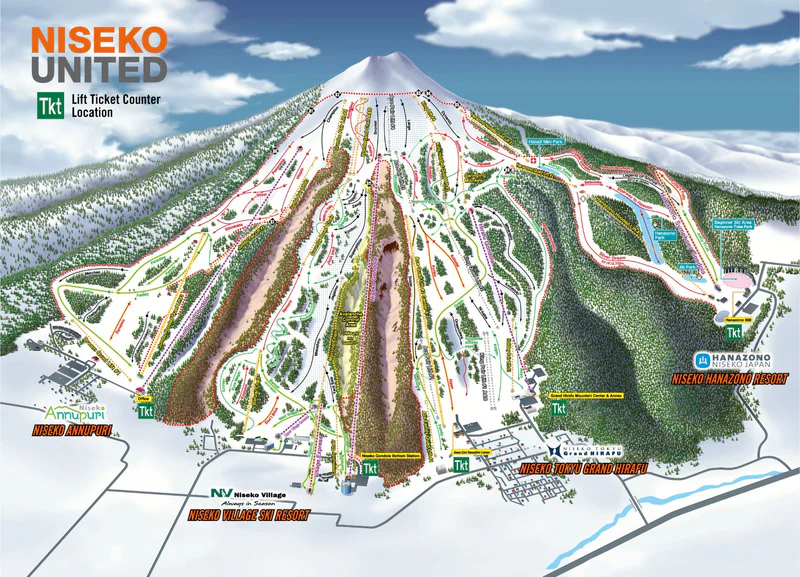
Niseko United: Four interconnected resorts with 90+ snow days per year. Ultra-dry Japow, the best English infrastructure in Japan, and the Niseko International Snowsports School (NISS) for lessons. Grand Hirafu is the most developed village, with the densest concentration of restaurants, bars, and lodging. The resort has a heavy Australian presence and food skews expensive by Japanese standards, but it remains one of the best places in the world to ski. Best for first-timers, all levels, groups. Books out fast for January and February.
Rusutsu: Niseko's quieter neighbour with the same Hokkaido snowfall and far fewer crowds. Three mountains with uncrowded tree runs. Best for intermediates who want Japow without the Niseko price and bustle.

Furano: Central Hokkaido's powder belt. Less developed for international visitors but deeply Japanese in atmosphere and food. Best for skiers who want consistent Japow and a more local feel.

Japanese Alps
Hakuba Valley: More local and less developed than Niseko, Hakuba can feel more authentically Japanese, which suits skiers who want infrastructure without the international resort atmosphere. Ten resorts under one pass with free inter-resort shuttles. Cortina, within the valley, has the best tree skiing in Japan. Steep alpine terrain with long verticals. 90 minutes from Tokyo by Shinkansen, then 1 hour by bus.

Nozawa Onsen: A traditional village with 18 free public onsens scattered through the streets. 300 hectares of terrain with steep runs. Books out faster than any other resort in Japan. Best for skiers who want the full Japanese mountain village experience.

Myoko Kogen: Five resorts with some of the deepest powder in Japan during strong snow years. Serious off-piste and backcountry terrain. Best for advanced skiers and powder hunters looking beyond Niseko.

Shiga Kogen: Japan's largest combined ski area. Eighteen resorts on one ticket, 80 kilometres of groomed trails, and the longest season of any major Japan resort (late November to May). Thirty minutes from Nagano Station and 30 minutes from the Snow Monkey Park. Best for skiers who want variety and value.

Kagura: One of Japan's highest resorts, averaging 600 inches of snowfall annually. Outstanding off-piste and tree runs. Best for expert skiers after serious backcountry and deep Japow without the crowds.

Gala Yuzawa: The only resort with a gondola connecting directly to a bullet train station. 75 minutes from Tokyo by Shinkansen. Best for Tokyo-based skiers who want a day trip or a short ski break without heavy logistics.

How much does a Japan ski trip cost?
A 7-day Japan ski trip costs between $1,665 and $5,335 USD per person. Flights are the biggest variable, eating 40–60% of the total budget. Once you are on the ground, Japan is more affordable than most people expect.
The Japanese Alps resorts tend to be cheaper than Niseko for accommodation and food. Hakuba and Nozawa Onsen are better starting points if budget is a priority. Multi-resort lift passes add value when you plan to ski across several resorts in a valley.
From November 2026, Japan's tax-free shopping shifts to a refund model. You pay full price at the register and file for a refund afterward. Verify the exact process before your trip if shopping is part of your plan.
How do you get to Japan's ski resorts?
Fly into Tokyo (Narita or Haneda). For Hokkaido, take a 90-minute domestic flight to Sapporo's New Chitose Airport, then a bus or car to your resort. For the Japanese Alps, take the Shinkansen to Nagano in 90 minutes, then a bus of around 1 hour to the resort.
United Airlines now operates a direct San Francisco (SFO) to Sapporo New Chitose (CTS) route, cutting connection time for US West Coast travellers.
Hokkaido transfers
Niseko: New Chitose Airport to Niseko by direct bus is around 3 hours. Budget half a day each way for the transfer. Private transfers are faster but significantly more expensive.
Rusutsu: Around 90 minutes from New Chitose by transfer or car.
Furano: Around 2 hours from New Chitose by bus.
If your Hokkaido itinerary includes time in Sapporo, the Sapporo Snow Festival runs in early February and is worth a half-day. It coincides with peak ski season, so expect crowds and higher hotel prices in the city that week.
Japanese Alps transfers
Hakuba: Shinkansen to Nagano (90 min from Tokyo), then 1 hour by bus. The Nagano Snow Shuttle runs direct from both Narita and Haneda to the resort.
Nozawa Onsen: Shinkansen to Iiyama Station, then around 30 minutes by taxi or shuttle.
Shiga Kogen: Shinkansen to Nagano, then 30 minutes by bus from Nagano Station.
Myoko Kogen: Shinkansen to Myoko Kogen Station (around 2.5 hours from Tokyo), then local transfer.
Gala Yuzawa: Shinkansen direct from Tokyo, 75 minutes. The gondola starts at the station.
Is the JR Pass worth it?
The JR Pass is not worth it for most Japan ski itineraries. Since the October 2023 price increase, a 7-day Ordinary JR pass costs ¥50,000. If you are skiing one region, Hokkaido or the Japanese Alps, individual Shinkansen tickets will almost always cost less. Tokyo to Nagano return is around ¥11,000. Tokyo to Hakata and back would be a different story.
The pass starts making sense if your trip crosses multiple distant regions and involves several long-haul bullet train legs. For example, combining Tokyo, Kyoto, Hiroshima, and a ski resort in one trip.
Where should you stay on a Japan ski trip?
Choose a ryokan for the full Japan cultural experience, a ski lodge for convenience and social atmosphere, or ski-in/ski-out accommodation for maximum time on snow. A mix of two styles across a two-week trip works well.
Ryokan

A traditional Japanese inn with tatami rooms, futon bedding, and an onsen on-site. Dinner and breakfast are typically included, with dinner a multi-course kaiseki meal. The experience is calmer and more structured than a hotel. Set routines around meals and bathing suit early starts and big ski days. Plan on 2–3 nights for the experience rather than a full stay.
Ski lodge

A practical base with a mix of western and Japanese-style rooms, breakfast usually included, and social common areas. Good for skiers who want convenience without the ceremony of a ryokan.
Ski-in/ski-out hotels

Niseko has the strongest selection in Japan, with international hotel brands and apartment-style options. Suits those who want to maximise time on snow and prefer a familiar setup.
Book 6–12 months in advance for January and February dates. Nozawa Onsen books out faster than any other resort in Japan.
What do first-time visitors need to know before skiing Japan?
Wash thoroughly before entering any onsen, never let your washcloth touch the bath water, and check the tattoo policy of your specific onsen before you arrive. Those three things cover the situations most first-timers get caught out by. The rest of Japan is easier than people expect.
Onsen etiquette
Use the shower stations before entering the communal bath. This is non-negotiable and a sign of basic respect for others sharing the water. Once inside, fold your small towel on your head or set it aside. Never wring it into the bath. Quiet is the norm, especially in the evening.
Tattoos and onsens
Many onsens historically banned tattoos due to their association with organised crime. Attitudes are changing, especially at resorts with high international visitor numbers. Niseko and Furano are the most tolerant ski regions in Japan. If you have visible tattoos: cover small ones with waterproof tattoo seals sold at Don Quijote stores, book a private kashikiri onsen rented per group, or contact your accommodation's onsen in advance to ask. Do not assume any onsen is tattoo-friendly without checking first.
Language
English signage and instruction is strong at Niseko, Hakuba, and the major Alps resorts. Smaller resorts are less consistent. Translation apps handle most day-to-day situations. Arigatou gozaimasu (thank you) and sumimasen (excuse me) go a long way at any resort.
Punctuality
Be on time for guide meetings, pre-booked taxis, and restaurant reservations. Japanese service culture runs on precision. A small nod or bow when greeting a guide or host is appreciated.
Plan your Japan ski trip with Stardrift
Stardrift is one of the best AI travel planners that builds a personalised day-by-day itinerary. Tell it where you and your travel companions are flying from, your budget, pace, dietary needs, and it creates a plan with bookable flights and hotels, and activities.
In the context of a Japan trip, if you are starting in Niseko, it accounts for the 90-minute domestic flight to Sapporo and the 3-hour bus before placing your first ski day.
Moving to the Japanese Alps, it routes the transfer around your actual travel windows. Restaurant suggestions at every stop already account for dietary needs you set once in Hokkaido. Your group is flying in from three different cities? One plan covers all of them.
Top features:
Live flight and hotel prices and booking options within the planning interface
Gmail booking detection (beta), Google Calendar sync, Outlook sync
A memory of your preferred airlines, hotel brands, dietary needs, and other special requests
Day-by-day itinerary with activities sequenced by neighborhood, timing adjusted for arrival times and check-in windows
Drag-and-drop editor with live map view
Starlink in-flight wifi availability by route and airline
Trip collaboration: invite links, @mentions, morning digest of overnight changes
New: Stardrift now imports places straight from TikTok and Instagram Reels and builds a full itinerary around them.
Start planning on Stardrift. No credit card required.
Frequently asked questions about skiing in Japan
Do I need a visa to ski in Japan?
Japan has visa exemption arrangements with 74 countries and regions, including the US, Canada, UK, Australia, New Zealand, and all EU member states. Citizens of these countries can enter visa-free for up to 90 days with a valid passport.
If your nationality requires a visa, Japan's eVisa system allows online applications for single-entry tourism stays of up to 90 days.
Do you need to bring your own ski gear to Japan?
Bring or rent powder skis, 80mm or wider underfoot. Standard carving skis will not float in Japow.
If you are bringing your own skis, check airline baggage fees before booking and consider Takkyubin, Japan's luggage forwarding service, which ships gear between resorts cheaply and reliably.
You can also use Takkyubin to forward your equipment from your final resort directly to your departure airport and collect it on the way out, so you are not dragging ski bags through the terminal on the day you fly home.
Is the JR Pass worth it for a Japan ski trip?
For most ski-focused itineraries, no. Since the October 2023 price hike, the 7-day JR Pass costs ¥50,000. Individual Shinkansen tickets or regional rail passes are typically cheaper when you are staying within one region. Use the Japan Rail Pass calculator at japan-guide.com to check your specific route before buying.
Can I visit the Snow Monkey Park on a Japan ski trip?
Yes. The Jigokudani Snow Monkey Park, where wild macaques bathe in outdoor hot springs, is 30 minutes from Nagano Station and around 30 minutes from Shiga Kogen. It is a practical half-day stop for anyone skiing the Japanese Alps. Most visitors combine it with a rest day or a day between resorts.
How far in advance should I book a Japan ski trip?
6–12 months for January and February travel. Nozawa Onsen books out the fastest of any resort in Japan. Niseko fills just as quickly in peak Japow weeks. For March or April travel, 3–4 months is usually enough. Locking in flights early gives more routing options and better prices.